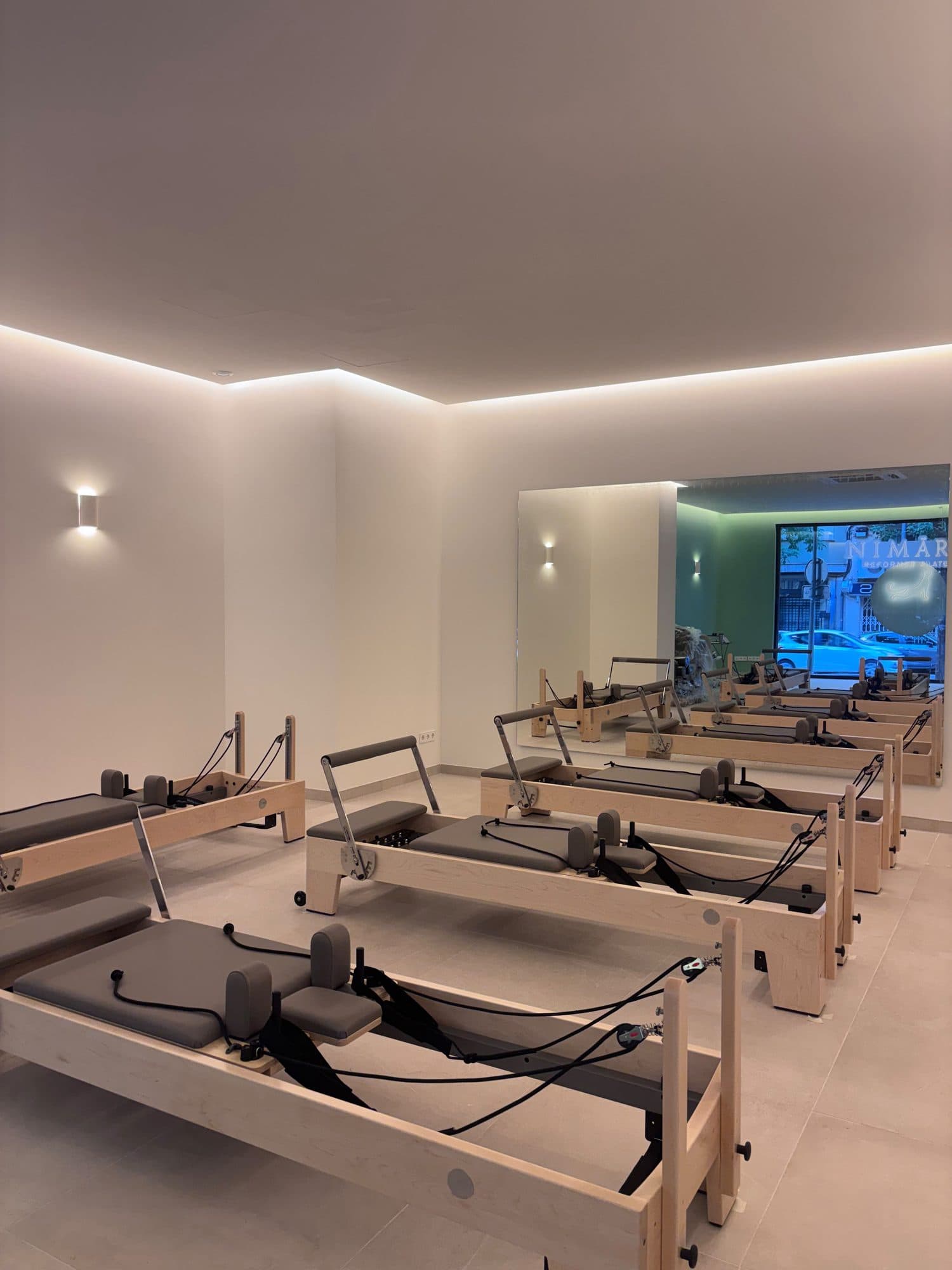
5 Benefits of Reformer Pilates You Haven’t Heard Before
If you’ve ever looked into Reformer Pilates, you’ve probably come across the usual list of benefits: better core strength, improved flexibility, enhanced posture. And while all of those are absolutely true, they barely scratch the surface of what this practice can do for your body and mind.
At Nimāra, we see the deeper transformations that happen when clients commit to regular Reformer practice. Here are five science-backed benefits that rarely make the headlines.
1. Refined Proprioception
Proprioception is your body’s ability to sense its position in space — the internal GPS that lets you walk without looking at your feet or catch yourself before a stumble. It’s a skill that naturally declines with age and sedentary lifestyles, but the Reformer is uniquely equipped to rebuild it.
The gliding carriage creates an unstable surface that constantly challenges your balance receptors. Unlike a fixed floor, the carriage moves beneath you, forcing your nervous system to make rapid micro-adjustments. Over time, these adjustments become automatic. Clients often tell us they feel more sure-footed walking on cobblestones, more confident on uneven terrain, and more graceful in everyday movement.
This isn’t just about athleticism. Improved proprioception is one of the most effective ways to prevent falls and injuries, especially as we age.
2. Fascia Health and Hydration
Fascia — the connective tissue web that wraps every muscle, organ, and bone — has only recently gained the attention it deserves in movement science. When fascia becomes dehydrated or adhesed (from sitting, stress, or repetitive movement), it restricts mobility and can create pain patterns that seem unrelated to their source.
The Reformer’s spring-loaded resistance creates a unique combination of stretch and load that is particularly effective at rehydrating fascial tissue. The slow, controlled movements encourage fluid exchange within the fascial layers, while the variable resistance allows you to work through different planes of movement that static stretching simply cannot reach.
Many of our clients at Nimāra notice that the “stuck” feeling in their shoulders or hips begins to dissolve after just a few weeks of consistent practice. That’s fascia releasing and rehydrating.
3. Nervous System Regulation
We live in a world that keeps our sympathetic nervous system — the fight-or-flight response — chronically activated. Reformer Pilates is one of the most effective movement practices for shifting your body back into parasympathetic mode.
The combination of rhythmic breathing, controlled movement, and focused attention creates what neuroscientists call a “flow state.” Your breath deepens, your heart rate variability improves, and your cortisol levels drop. The springs provide just enough resistance to keep you engaged without triggering a stress response, unlike high-intensity training that can further activate the sympathetic system.
This is why so many clients leave our studio feeling energised yet calm — a state that’s surprisingly rare in modern fitness. It’s not just a workout; it’s a nervous system reset.
4. Joint Decompression
Most exercise loads your joints with compressive forces. Running, weight training, even walking — gravity pushes your bones together. The Reformer is one of the few pieces of equipment that can create traction, or decompression, through the joints.
When you push away from the footbar or pull the straps, the spring resistance creates a gentle traction force that opens up space in the joints. This is particularly valuable for the spine, hips, and shoulders — areas where compression tends to accumulate and cause discomfort.
For anyone dealing with joint stiffness, early arthritis, or the cumulative effects of desk work, this decompressive quality makes the Reformer far more joint-friendly than most alternatives. It’s exercise that creates space in the body rather than compressing it further.
5. Interoceptive Body Awareness
Interoception — the ability to sense what’s happening inside your body — is increasingly recognised as a cornerstone of mental and physical health. People with strong interoception are better at regulating their emotions, recognising hunger and fatigue cues, and responding appropriately to stress.
The Reformer cultivates this awareness like few other practices. The constant feedback from the springs, the precise alignment cues from your instructor, and the need to monitor multiple body parts simultaneously all train your brain to listen more closely to your body’s signals.
At Nimāra, our instructors guide you to notice subtle sensations — the difference between effort and strain, the moment a muscle engages versus grips. This internal attentiveness carries over into daily life, helping you make better decisions about rest, nutrition, and movement outside the studio.
The Deeper Practice
Reformer Pilates benefits extend far beyond what’s visible in the mirror. It’s a practice that rewires your nervous system, rehydrates your tissues, and reconnects you with your body’s innate intelligence. If you’re curious to experience these benefits for yourself, we’d love to welcome you to Nimāra for your first class.