Reformer Pilates vs Mat Pilates: Which Is Right for You?
One of the most common questions we hear at Nimāra is: “What’s the difference between Reformer and Mat Pilates?” It’s a fair question. Both carry the Pilates name, both focus on controlled movement and core engagement, and both were developed from Joseph Pilates’ original method. But in practice, they offer quite different experiences and benefits.
Rather than declaring one superior to the other, let’s look honestly at what each offers and when you might choose one over the other.
The Fundamental Difference
Mat Pilates uses your own body weight as resistance. You work on a mat, sometimes with small props like resistance bands, balls, or magic circles, but the primary challenge comes from moving your body against gravity.
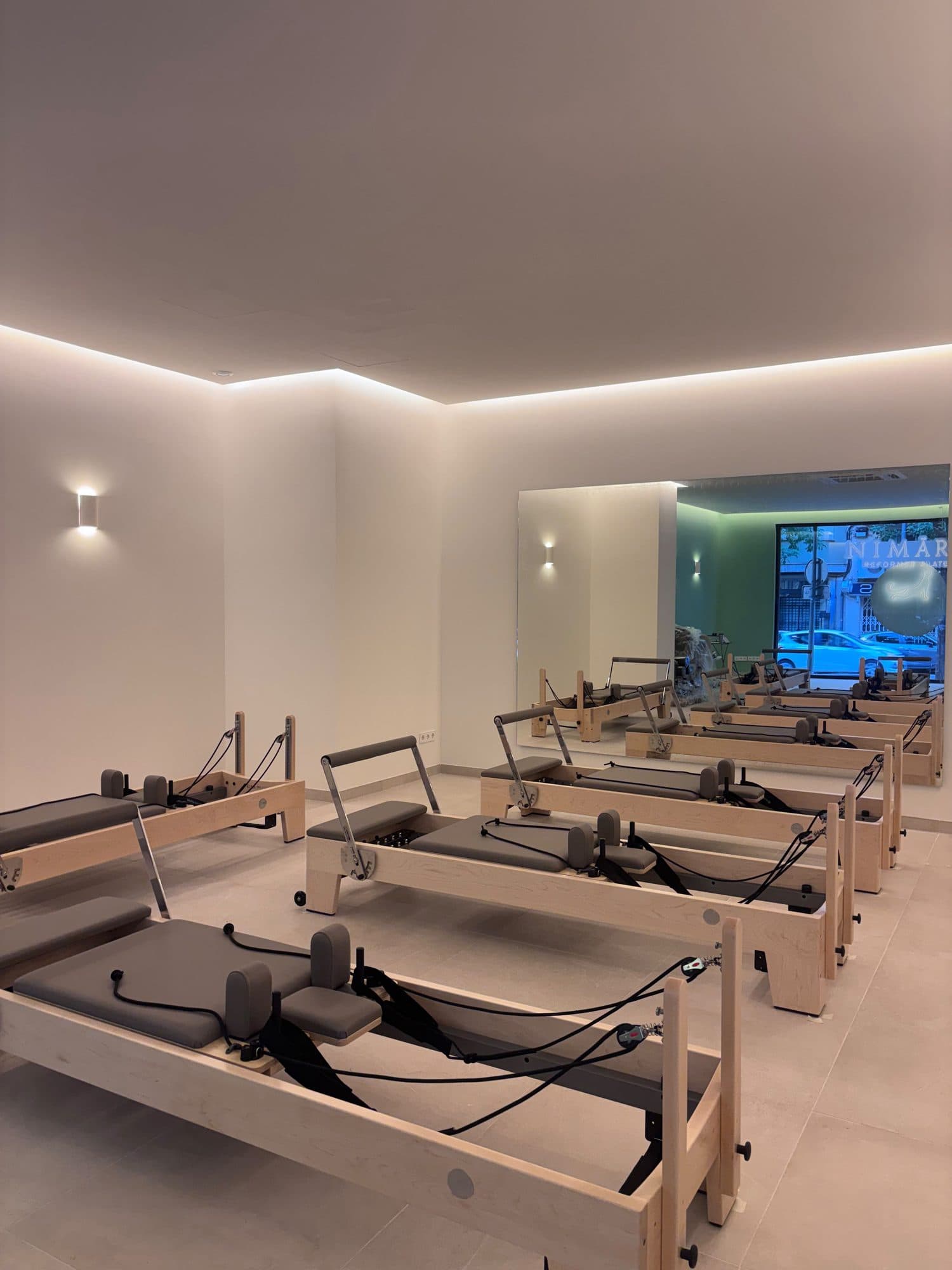
Reformer Pilates uses a specialised piece of equipment — the Reformer — which provides variable spring resistance. The sliding carriage, springs, straps, and footbar create a system where resistance can be adjusted, direction of movement can be changed, and your body is supported in ways that aren’t possible on a mat.
This distinction matters more than it might seem.
When the Reformer Has the Edge
For beginners and rehabilitation: This might seem counterintuitive — the Reformer looks more complex, so surely the mat is simpler? In reality, many fundamental Pilates exercises are easier to learn on the Reformer because the springs provide assistance. A roll-up that’s impossible on the mat becomes accessible with spring support. The carriage guides your movement path, reducing the chance of compensating with the wrong muscles.
For joint-friendly exercise: The Reformer’s horizontal orientation means you’re working against spring resistance rather than gravity, which significantly reduces joint compression. For anyone with knee, hip, or spinal issues, this can make the difference between a practice that heals and one that aggravates.
For targeted muscle work: The spring system allows precise control over resistance levels and angles. An instructor can isolate specific muscle groups with a specificity that’s difficult to achieve on the mat. This makes the Reformer particularly valuable for addressing imbalances, which most of us carry without realising.
For variety and engagement: The Reformer offers hundreds of exercise variations across multiple body positions — supine, seated, kneeling, standing, side-lying, and prone. This variety keeps the practice mentally engaging and allows for creative programming that evolves with your abilities. At Nimāra, no two classes feel the same.
For eccentric training: The spring resistance challenges you in both directions of movement — pushing out and controlling the return. This eccentric (lengthening under load) component is crucial for building functional strength and is one of the Reformer’s unique advantages.
When Mat Pilates Shines
For building raw core strength: Without the Reformer’s support, your core must work harder to stabilise your body against gravity. Advanced mat exercises like the Teaser, Boomerang, and Control Balance are genuinely demanding and build deep functional strength that translates directly to daily life.
For portability and accessibility: You can do mat Pilates anywhere — at home, in a park, while travelling. All you need is a mat and some floor space. This makes it an excellent complement to studio-based Reformer work.
For body weight mastery: There’s something pure about learning to control your own body in space without external assistance. Mat work develops a relationship with gravity and body weight that builds profound body awareness.
For cost: Mat classes are typically less expensive than Reformer sessions, and home practice is essentially free once you know the exercises. This makes it a more accessible entry point for many people.
How They Complement Each Other
The most seasoned Pilates practitioners tend to do both, and for good reason. The Reformer builds strength and mobility in supported positions, while the mat challenges you to maintain that control without assistance. Skills learned on the Reformer — breath patterns, muscle engagement, spinal articulation — deepen your mat practice. And the raw strength demands of mat work enhance your Reformer performance.
At Nimāra, we focus on Reformer Pilates because we believe the equipment allows us to offer the most personalised, effective, and safe experience for our clients. The spring resistance, combined with our small class sizes of six, means we can meet each person exactly where they are and progress them thoughtfully.
That said, we always encourage our clients to explore mat work as a supplement to their Reformer practice — especially for building a home routine between studio sessions.
Making Your Choice
If you’re completely new to Pilates, we’d actually recommend starting on the Reformer. The spring assistance and guided movement path make it easier to learn proper form, and the immediate feedback from the equipment helps you understand what correct engagement feels like. Many of the body awareness skills you develop on the Reformer will serve you well if you later explore mat work.
If you’re returning from injury or managing a chronic condition, the Reformer’s joint-friendly, adjustable resistance makes it the safer choice. Your instructor can modify spring settings to accommodate your needs in ways that aren’t possible on the mat.
If you’re an experienced mover looking for a new challenge, the Reformer will surprise you. The precision required, combined with the variable resistance, reveals blind spots in even the most conditioned bodies.
Ultimately, the best form of Pilates is the one you’ll practise consistently. Both will make you stronger, more mobile, and more connected to your body. And if you’re ready to try the Reformer, we’d love to see you at Nimāra.